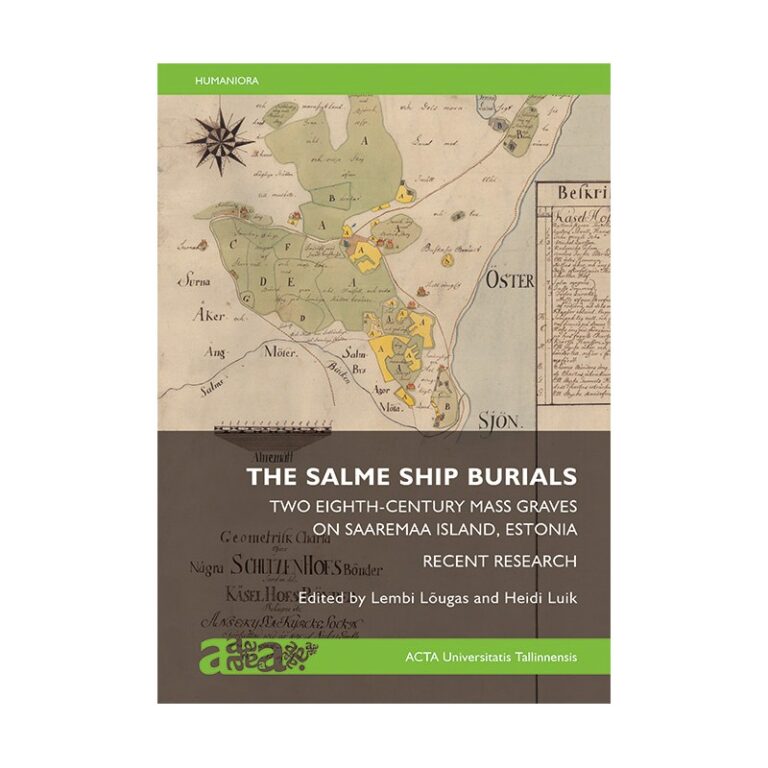
A new volume on the Salme ship burials has been published: The Salme Ship Burials: Two Eighth-Century Mass Graves on Saaremaa Island, Estonia. Recent Research. Edited by Lembi Lõugas and Heidi Luik.
The Salme ship burials, discovered in 2008 and 2010 on Saaremaa Island in Estonia, represent a unique and significant archaeological site that continues to provide valuable material for interdisciplinary research. A collection titled Recent Research presents thirteen articles that explore various aspects of the site, demonstrating that the Salme complex still offers many avenues for future study.
The research is divided into five main themes. First, studies of the landscape (including cultural landscape) explain how the local society, environment and coastline looked at the time of the burials. Second, analysis of weapons — especially decorated swords — reveals information about craftsmanship and long-distance connections.
Third, personal items such as gaming pieces, combs, and brooches provide insight into the daily life and culture of the buried warriors. Fourth, researchers use modern methods like 3D modelling and photogrammetry to reconstruct the ships and better understand their structure.
Finally, studies of human and animal remains show that the buried men likely died violently and give information about their health, diet, and origins. The presence of dogs and birds of prey suggests they had special cultural importance in burial practices.
Overall, the publication highlights the multidisciplinary nature of Salme research and emphasizes that the site remains an important source for understanding pre-Viking and early Viking Age societies, warfare, and burial traditions.
The book brings together no fewer than 13 new studies, including Marika Mägi’s article “The Cultural Landscape Around the Salme Find.”
The book is available for purchase from Tallinn University Press as well as from major bookstores.