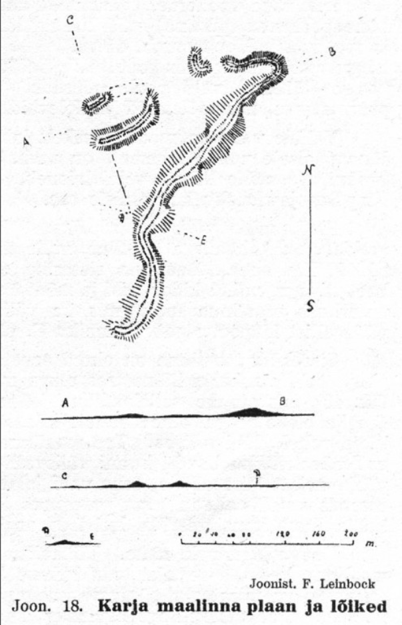
Drawing of Purtsa hillfort from the 1924 publication “Saaremaa ja Muhu muinasjäänused”. Photo: F. Leinbock.
Purtsa hillfort, also known as Pamma hillfort, Karja hillfort, and Kooljamäed (‘Hills of the Dead’), is located in northern Saaremaa, in the Karja and Pamma area. The site is considered one of the possible locations of the bloody battles fought between the inhabitants of Saaremaa and the forces of the Teutonic Order during the winter of 1344, in connection with the St George’s Night Uprising (1343-1345).
Purtsa hillfort is situated on the western edge of an elevated area surrounded by marshes and forests. A Late Iron Age cemetery is located in the southeastern part of Kooljamäed and to the east and south of it, from which the name Kooljamäed may also derive. The cemetery once covered a relatively large area, extending from the southeastern edge of the hillfort approximately three-quarters of a kilometre to the east and south. According to earlier descriptions, there were approximately 200 stone graves, measuring 4-6 metres in diameter and around half a metre in height. The graves were covered by a layer of stones approximately half a metre thick, beneath which burnt soil and human bones were discovered. Some of the graves had already been destroyed by agricultural activities by the early 20th century, although intact stone cairns could still be found in the pastures.
Several archaeological finds are also known from the cemetery. For example, in 1910, a silver penannular brooch was discovered in one stone grave, while a copper coin with a worn inscription was found in another. Burnt bones were also recovered from both graves. A sword was reportedly once discovered in a field belonging to Mihkli farm in Purtsa village. Other artefacts associated with the Kooljamäed area include a spearhead, a knife blade, a bronze bracelet, a penannular brooch, chain fragments, and various other objects. These finds indicate that the area was already in use before the events of the 14th century and that it served as a significant burial ground.
Attempts to investigate Purtsa hillfort archaeologically date back to the late 19th century. In 1895, Stackelberg and Bogojawlensky conducted excavations at the site, digging trial trenches approximately 50 centimetres deep over the course of a single day, but made no significant discoveries. According to local folklore, gold and other valuable objects were supposedly buried in the sand layer of Kooljamäed, although no archaeological evidence has yet been found to substantiate these stories.
Later investigations have likewise yielded no significant results. The Kooljamäed area has virtually no archaeological cultural layer, and it is difficult to interpret the arrangement of the natural formations as a hillfort. Although the possibility of finding traces of human activity somewhere in Kooljamäed cannot be ruled out, these would clearly not be sufficient to indicate the presence of a hillfort.
According to an interpretation originating with Baltic German scholars, this stronghold may have been Purtsa hillfort, since the Karja area is mentioned in connection with subsequent events in 1345. However, there is no actual basis for assuming that the events of 1344 must therefore also have taken place within the territory of the later Karja parish. According to more recent theories, the stronghold besieged in 1344 was more likely Valjala hillfort, which archaeological excavations have shown to have been hastily refortified in the first half of the 14th century, several decades after its abandonment.
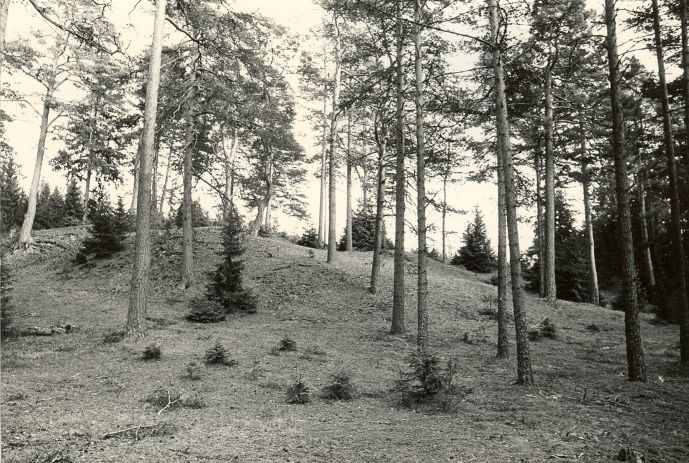
View of the possible Purtsa hillfort from the southwest (1984). Photo: E. Väljal.
To the west of the hillfort, approximately 100 metres from the inner ramparts, lies a flat area of around 2,000 square metres, popularly known as Vereväli (‘Field of Blood’). The terrain is low-lying and sandy, with groundwater occasionally accumulating on the surface. According to local tradition, this was the site where the inhabitants of Saaremaa were massacred. However, this is probably an example of so-called secondary folklore: when Baltic German historians began associating the events of 1344 specifically with Karja parish, local people came to believe that they had already heard these stories from their ancestors.
In any case, it is relatively certain, and directly supported by the chronicles, that during the second military campaign in 1345, the forces of the Teutonic Order ravaged the Karja area.
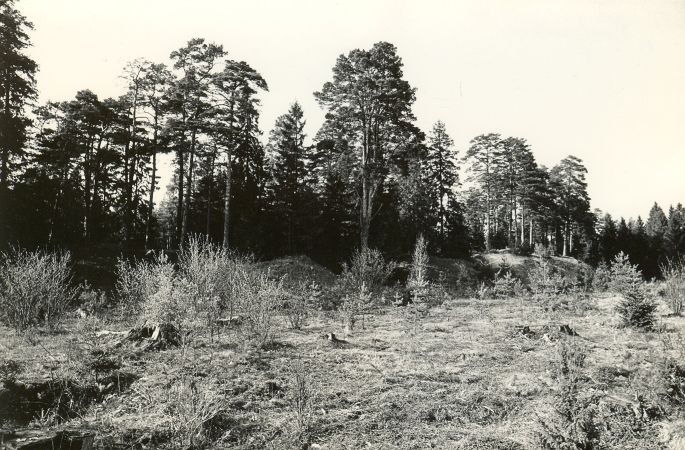
View of the possible Purtsa hillfort from the southeast (1984). Photo: E. Väljal.
Although the precise role of Purtsa hillfort in the battle of 1344 has not been conclusively established, it remains a noteworthy historical site that has become embedded in local memory and place names as the setting of one of the most dramatic episodes in Saaremaa’s history.