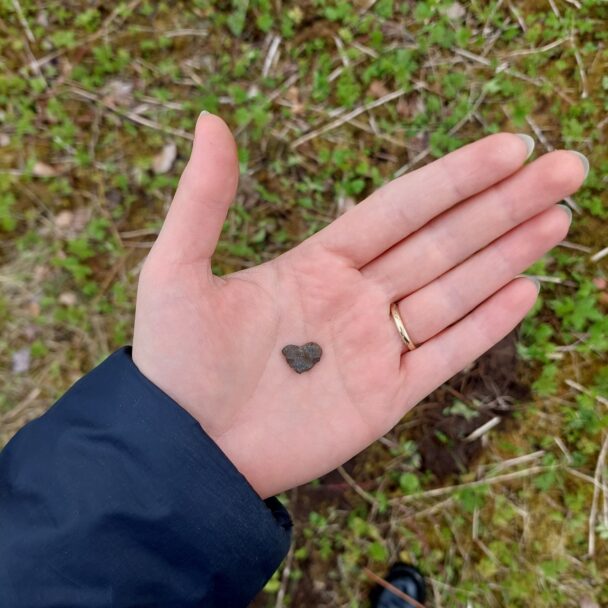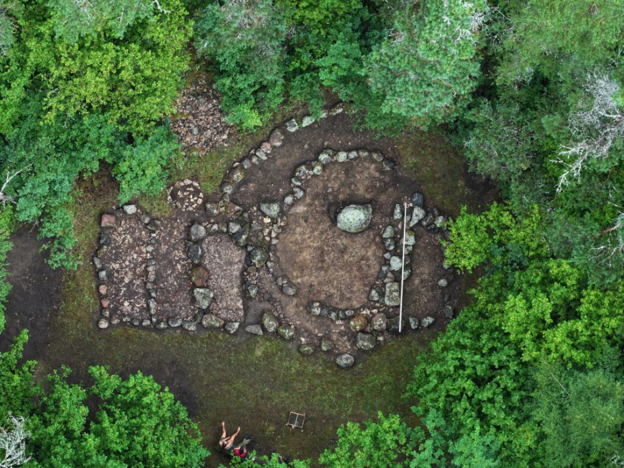
Mäla stone grave. Photo: Kristo Oks.
The Mäla stone grave, also known as the Ussimätta or Ussimäe grave (Snake hill in Estonian), is located in Mäla village on the island of Muhu, approximately 170 metres west of the Pädaste–Liiva road. It is situated in gently undulating terrain, now covered by forest, with the remains of ancient fields also found nearby. Together, these form an important archaeological complex that provides valuable information about settlement patterns and burial practices on Muhu around the beginning of the Common Era.
The grave’s precise construction history and period of use have not yet been conclusively established. The Mäla stone grave is particularly noteworthy for its unusual structure. Measuring approximately 9.8 × 9.2 metres, the grave consists of two concentric stone circles and four small rectangular burial compartments (tarands), three of which are situated to the west of the stone circles and one to the east. The distance between the two stone circles is approximately 1.4 metres.
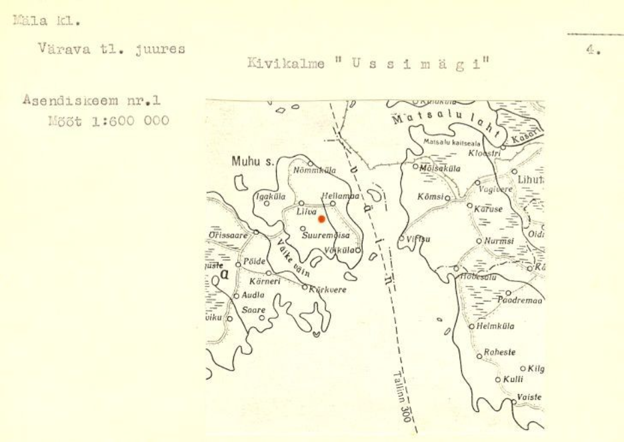
Location of the Mäla stone grave on the island of Muhu. Source: Archaeological monument record compiled by Vello Lõugas.
The ancient burial sites of Mäla village attracted interest as early as the 19th century. The first known archaeological investigations in the area were carried out by J. B. Holzmayer in 1874. In 1895, the artist Ants Laikmaa wrote about the site to the antiquarian Jaan Jung. According to Laikmaa, it was an ancient burial ground where coins, various artefacts, and cremated human bones had reportedly been discovered, and which was known as “Ussimätas”. According to local folklore, Ussimätas received its name because numerous snakes were said to have lived there. Oral traditions recorded later also mention the discovery of ancient objects, including weapons and human and horse bones, during gravel extraction near the grave. Although these accounts indicate the historical significance of the area, not all the reported finds can be reliably associated with the Mäla stone grave known today.
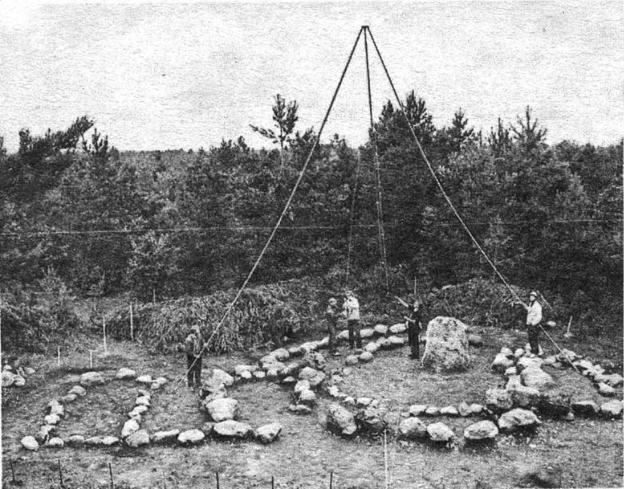
Photographing the Mäla stone grave in 1985. Source: J. Selirand and V. Lõugas. (1988). Arheoloogia Eestimaa teedel. Tallinn, p. 198.
Further archaeological excavations were carried out at the Mäla stone grave in 1984–1985 under the direction of archaeologist Vello Lõugas. The finds consisted mainly of uncremated human bones, although a few fragments of cremated bone, pottery sherds, fragments of temple ornaments and shepherd’s crook pins, and a broken knife were also discovered. Based on the archaeological finds, the tarands were dated to the Pre-Roman Iron Age, while the precise age of the burial area enclosed by the stone circles remained uncertain.
Lõugas initially interpreted the grave as a transitional form between a stone-cist grave and a tarand grave. In his view, the burial area enclosed by the stone circles was constructed first, with the small tarands added later. According to this interpretation, the burial site developed over several construction phases. Archaeologist Marika Mägi, however, has suggested that the grave may instead represent a distinctive variant of the small-tarand graves characteristic of Saaremaa and other coastal areas of western Estonia.
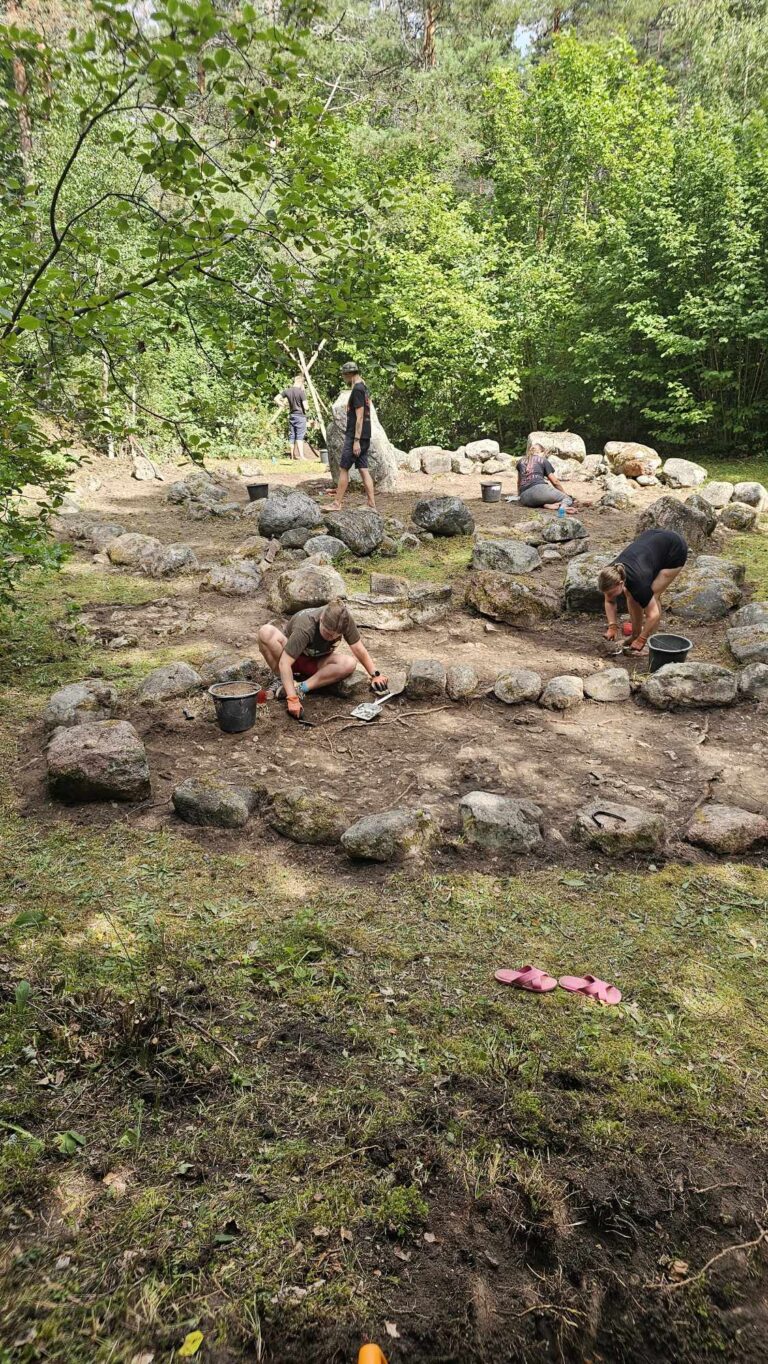
Excavations in 2024. Photo: Mairi Kaseorg.
In 2024 and 2025, University of Tartu archaeologists Mairi Kaseorg and Karin Rannaäär directed fieldwork at Mäla. Their aim was to sieve the spoil heaps left by the excavations of the 1980s, as systematic sieving of excavated soil was not common practice at the time. They also sought to clean and document the grave using modern methods.
During the investigations, it became apparent that parts of the grave’s structures and cultural layer had remained unexcavated during the earlier archaeological work. The investigations were therefore extended to include these areas. Noteworthy new finds include fragments of iron shepherd’s crook pins, a child’s bracelet, pottery sherds, quartz, flint, and a piece of chewed resin. In 2024, more than 150 pottery sherds and over 300 grams of bone were recovered, most of which were uncremated.
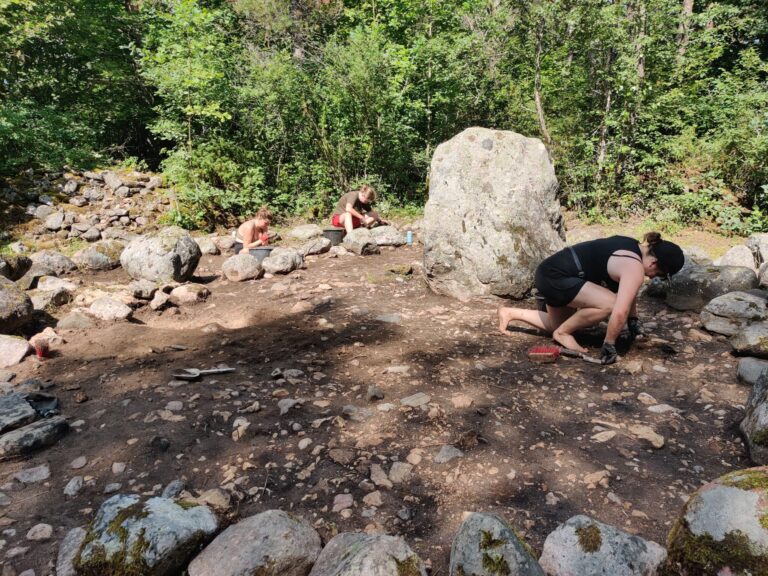
Excavations in 2024. Photo: Mairi Kaseorg.
The new finds are important for both dating the grave and understanding the burial practices associated with it. Particularly noteworthy are the fragments of shepherd’s crook pins, which support the possibility that the burial area enclosed by the stone circles may also date to the Pre-Roman Iron Age. The pottery sherds may likewise provide new insights into the production and use of ceramics on Muhu and other western Estonian islands during this period.
The latest investigations have revived the hypothesis that the stone circles and cairns may not have been constructed at different times, as previously believed. It is possible that the entire burial complex was built simultaneously and that its structural design was more complex than previously assumed. According to one possible interpretation, the site represents a stone cairn grave enclosed by stone circles, with an irregular internal structure and no central stone cist.
During the fieldwork, a small stone spiral located near the grave was also documented. As it is not visible in photographs from the 1980s, it may be a later construction.