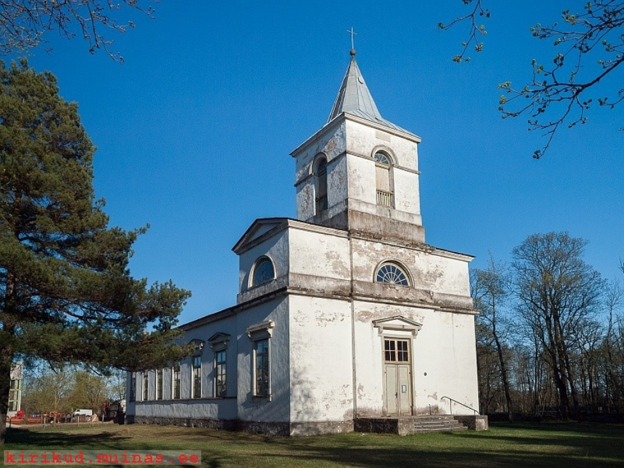
Kärla Church, viewed from the northwest (2009). Photo: M. Viljus.
Kärla Church is located in western Saaremaa, at the junction of three roads, on a high slope overlooking a river valley. It is dedicated to St Mary Magdalene, and the present church was built in 1842–1843 on the site of a medieval church.
During the prehistoric and medieval periods, the landscape in the southern part of Kärla parish differed considerably from that of today. Mullutu Bay extended far inland, and important harbour sites were located along its shores during the Viking Age and the Middle Ages. The medieval church stood approximately 7 km from the coastline, along the Kärla River. According to the treaty of 1234, Kärla belonged to the Kaarma (Carmele) district and remained part of the possessions of the Bishop of Saaremaa (Osilia) until the end of the Middle Ages. Kärla (Kergel) parish is first mentioned in written sources only in 1438.
According to local folklore, the church was originally intended to be built near Kõrkküla, where the remains of the walls of an earlier chapel can still be found. However, spirits were said to have destroyed the construction work at night, and a new site was eventually chosen with the help of oxen. A similar legend is also associated with Karja Church.
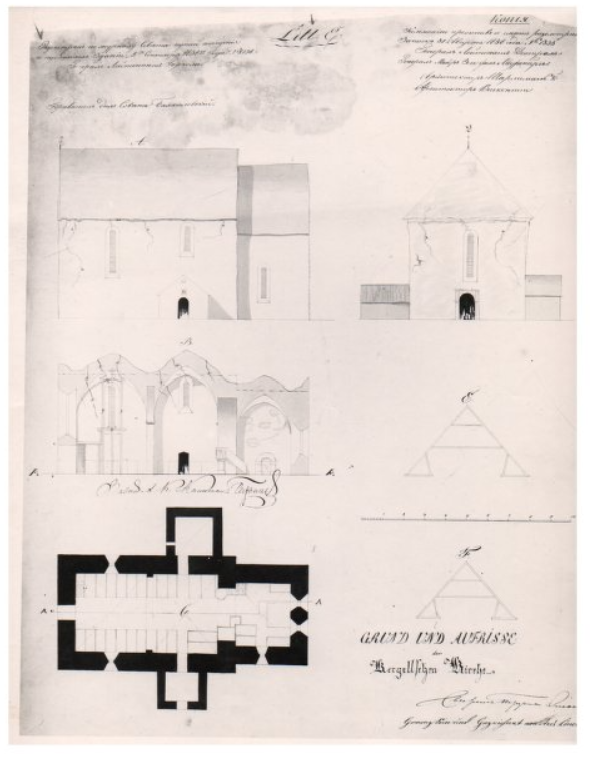
Drawing of the medieval Kärla Church discovered by Ants Hein in the Central State Historical Archive in St Petersburg. F. 1488, inv. 2, file 580, fol. 1.
The only surviving visual source depicting the medieval church is a drawing from 1838, made shortly before its demolition. According to the drawing, it was a towerless church consisting of a rectangular chancel and a wider, single-aisled nave, with overall external dimensions of 11.7 × 25.6 m. The closest surviving architectural parallels to this type of church, which have retained their original form, are the churches of Karja and Muhu.
Several characteristic architectural features suggest an early construction date for the first stone church. The church had narrow Romanesque round-arched windows, paired windows in the eastern wall of the chancel, and walls measuring 1.9 m in thickness. Similar features found in other churches on Saaremaa suggest that the first stone church at Kärla was also built as early as the 13th century. The stone church was probably preceded by a wooden church.
In 2009, approximately twenty burials were excavated next to the church, some of which contained grave goods dating to the 13th century.
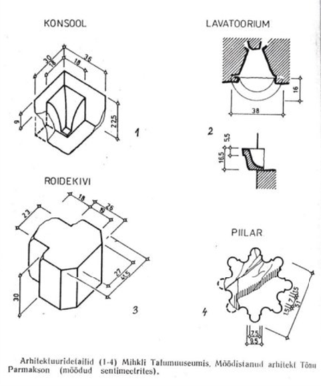
Carved stone architectural elements from Kärla Church, discovered at Mihkli Farm Museum. Source: Eesti NSV Teaduste Akadeemia kodu-uurimise komisjon Kingissepa rajoonis.
In 1779, a carved stone bearing a Latin inscription was discovered in the church wall, stating that the stone-built Church of St Mary Magdalene was consecrated on 22 July 1313. The nave is known to have originally been unvaulted, although it had been designed to accommodate vaulting. The year 1313 may therefore mark the final completion of the church rather than the beginning of its construction.
Traces of the medieval church have also been discovered at Mihkli Farm Museum, where several carved architectural stones were found incorporated into the wall of a sauna. These included a vault-rib corbel, an octagonal column shaft segment characteristic of the period, and a transverse arch voussoir suggesting a date at the beginning of the century. Based on these finds, it has been suggested that the nave was not vaulted until the early 15th century. Thus, the medieval church may have undergone three distinct phases of construction.
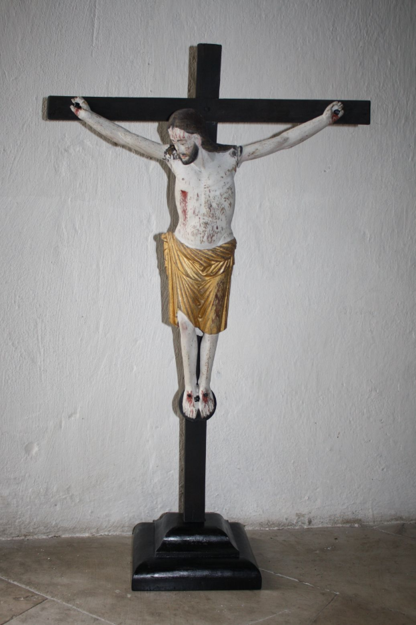
The Kärla Crucifix. SM_9530:1 Ks 80; Saaremaa Museum Foundation; SM_9530_1Ks80_1_pisipilt.jpg.
Among the surviving medieval furnishings are a baptismal font basin and a crucifix, which recent research has dated to the first half of the 13th century. The back of the figure, and probably also its head, originally contained a sepulchrum, a cavity traditionally used to hold a relic or a fragment of the consecrated Eucharistic Host. The crucifix is the oldest and one of the most valuable wooden sculptures in Estonia and is currently on display at Saaremaa Museum.
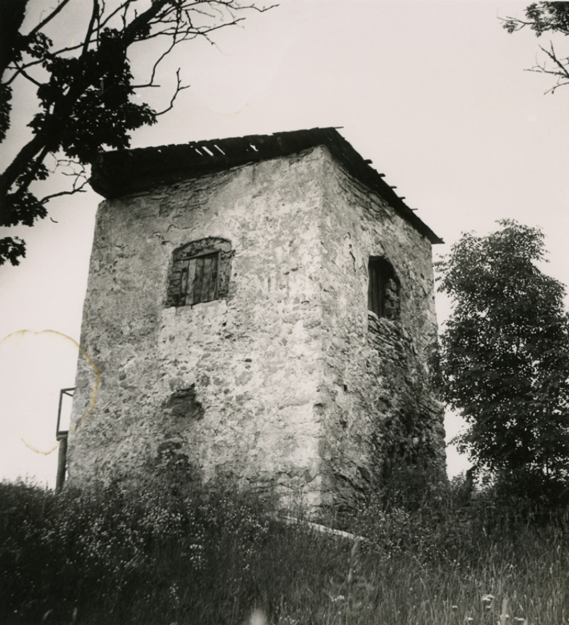
The bell tower of Kärla Church. EAM Fk 5836; Museum of Estonian Architecture; EAMFk5836_1_pisipilt.jpg.
According to later sources, the church was damaged by a fire in 1556 but was subsequently restored. A freestanding bell tower, similar to the one at Kihelkonna, was most likely erected in 1614. Unfortunately, it has not survived, as it was demolished in 1981 on the orders of the chairman of the local kolhos.
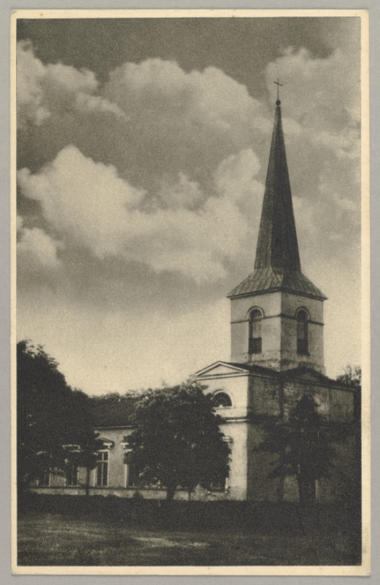
Postcard depicting Kärla Church (1936). AM_4567:75 F 16128; Estonian History Museum; 607846_AM4567_75_F16128_aa_pisipilt.jpg.
By 1836, the medieval church was in danger of collapse. It was demolished in 1842, and a new church was built on the same site using limestone, with carved architectural details made of dolomite. The new church was consecrated on 22 July 1843, the feast day of St Mary Magdalene.
The building is a single-aisled church in a restrained Neoclassical style, with no separate chancel. It features a tripartite western façade with a square tower at its centre. Characteristic architectural elements include windows with pediments supported by consoles, prominent cornices, circular windows and a flat ceiling.
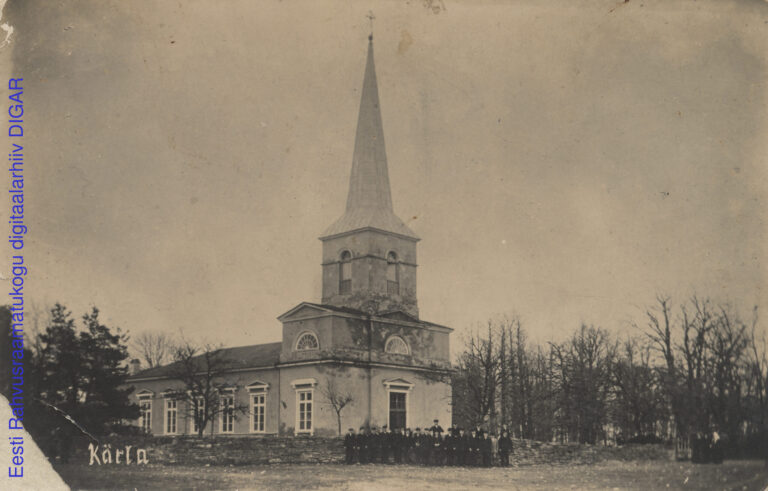
The 20th century was a difficult period for the church. In 1908, a new spire was built to replace the one destroyed by a lightning-induced fire. During the First World War, in 1915, the church bells were taken to Russia. In 1940, the Soviet authorities pulled down the tower using a tractor. The church was used as a military barracks and the organ was destroyed. The tower, subsequently rebuilt with a Neo-Gothic pyramidal spire, is only half the height of its predecessor.