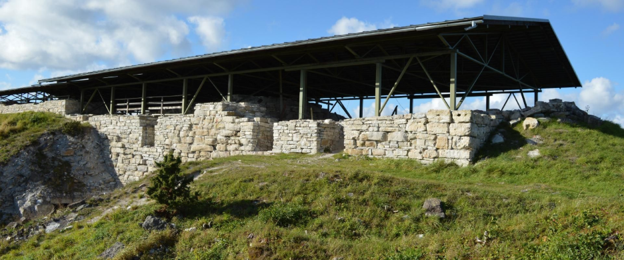
Maasilinn. Photo: Saaremaa TIK.
Maasilinn (also known as Maasi Castle, German: Soneburg) is a former castle of the Livonian branch of the Teutonic Order in eastern Saaremaa. For more than two centuries, the castle served as the administrative centre of the Order’s Maasilinn bailiwick and was one of the most important centres of power on Saaremaa. In 1576, it was blown up during the Livonian War.
Before the establishment of Maasilinn, the Order’s administrative centre was located at Pöide. However, following the St George’s Night Uprising (1343-1345), the Livonian Master Burchard von Dreileben ordered the construction of a new castle on the northern coast of Pöide. The entire district subsequently became known as the Maasilinn or Soneburg bailiwick.
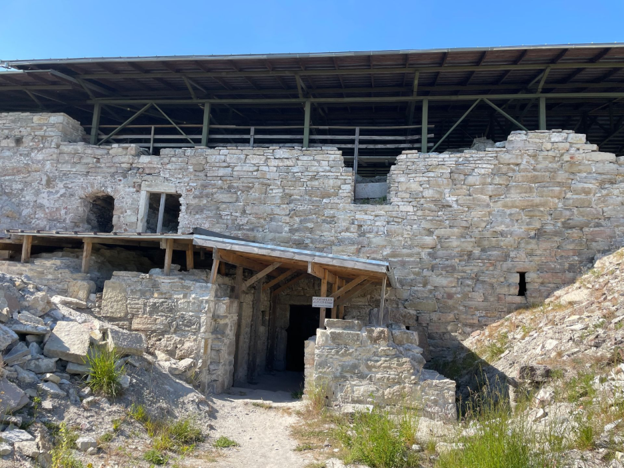
Photo: Kati Aus.
According to legend, the construction of the castle was intended as punishment for the uprising, and the inhabitants of Saaremaa were required to build it themselves. This is also reflected in its German name, Soneburg, which has been interpreted as “penalty castle” or “punishment castle”, although a more accurate translation would be “castle of reconciliation”. The original castle was built of wood, while the stone castle was constructed during the rule of the Livonian Master Goswin von Herike (1345-1359), although it was not fully completed until the following decades.
According to the chronicles, following St George’s Night Uprising, the inhabitants of Saaremaa were required to demolish their own stronghold, known as “Mapenzar”. According to the linguist Wiedemann, the area around Maasilinn was still called “Maansaar” in the 19th century, leading to the suggestion that some form of local fortification may have existed on the site of the later Maasilinn Castle in the 14th century.
The interpretation of Maasilinn as a punishment castle emerged later. Sources written closer to the time of St George’s Night Uprising indicate that the inhabitants of Saaremaa were only obliged to demolish, or perhaps rather surrender, their own stronghold. This gave the Order an opportunity to construct its own castle independently of the existing infrastructure.
The harbour at Maasilinn was a particularly favourable choice. At the time, it is believed to have been sufficiently deep, while the castle’s location also allowed control over the waterway through the Väike Strait, which was still in use during the Middle Ages. The presence of nearby stone quarries was undoubtedly another important factor in the choice of location.
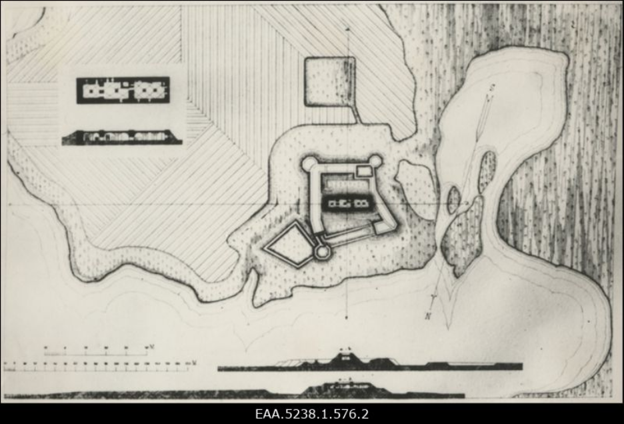
General plan of Maasilinn Castle. Photocopy from the collections of the Ethnographic Museum, 568:3. EAA.5238.1.576.2.
Maasilinn is a typical elongated castle enclosed by a curtain wall, with its main building also described as an enlarged residential tower. Built of Saaremaa dolomite and limestone, the main building measures 46.9 × 12.2 metres and was constructed in two phases. The older western section is 20.8 metres long and contains two pillars, while a 26.1-metre-long extension was added later. The walls of the older section are 2.1-2.3 metres thick, while those of the newer section measure 2.7-3 metres in thickness. Both sections had three storeys.
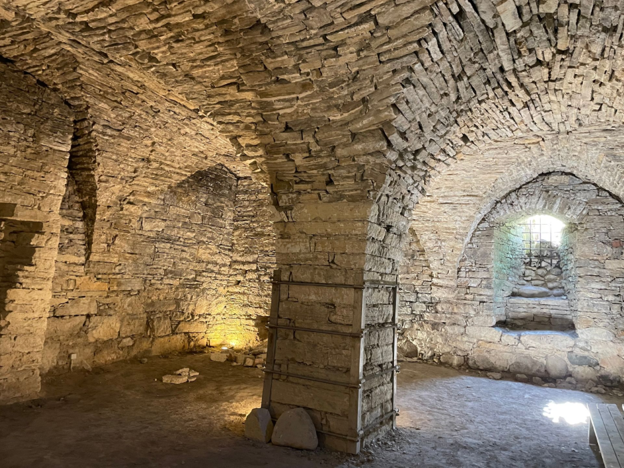
Photo: Kati Aus.
The surviving ground floor consists of three rooms: two have a single pillar each, while the third has two. The massive rectangular pillars support simple limestone groin vaults. Staircases were located in the southern wall of the older section, alongside a large hooded fireplace and a hypocaust heating system with a stone-filled furnace. The entrance gates to this section were located on the eastern side.
The main building was surrounded by a spacious, irregularly rectangular curtain wall, with sides measuring 70-90 metres in length. Additional buildings were constructed in several phases against the northwestern, northeastern, and southeastern sections of the curtain wall. The wall was reinforced by projecting, semicircular, open-topped artillery towers and, later, by earthen fortifications. The entire castle was surrounded by a moat, which was connected to three large fishponds located to the south of the castle.
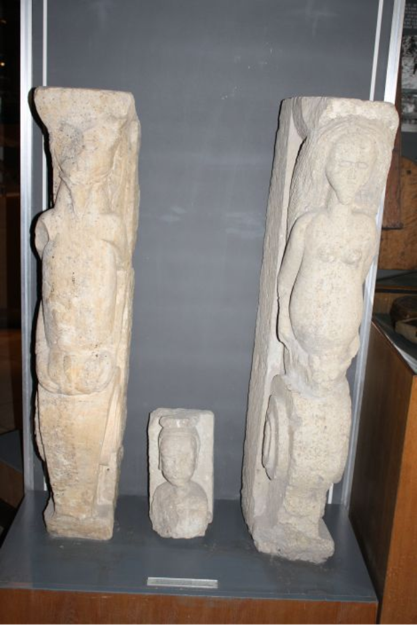
Dolomite sculptures discovered among the ruins of Maasilinn Castle, believed to date from the 15th century. The figures are traditionally identified as Adam (left) and Eve (right). Both are now on display at Saaremaa Museum. Eve (SM_321 Ks 96); Saaremaa Museum Foundation; SM_321Ks96_1_pisipilt.jpg.
Major alterations were undertaken in 1518 by the bailiff Tonys Ubelacker, under whose direction part of the outer bailey was probably constructed. The artillery towers at the corners of the outer bailey, however, date from an even later period, as indicated by carved architectural details in the Renaissance style discovered there.
During the Livonian War, however, the Order’s rule over the castle came to an end. In 1564, the last bailiff, Heinrich Lüdinghausen-Wulf, surrendered the castle and its associated lands to Denmark. The Danes destroyed Maasilinn Castle in 1566, but it was soon rebuilt. However, in late July 1568, the Swedes, led by Klaus Kursell, captured the castle. Under the subsequent armistice, eastern Saaremaa, which had been administered from Maasilinn, together with Muhu, passed into Swedish hands.
The Swedes established the Maasilinn castle fief from these territories, administered by a castle bailiff. By the end of 1570, these lands formed part of the duchy of Duke Charles of Södermanland.
However, Muhu was returned to the Danes as early as 1573, followed by Maasilinn a year later. But in the autumn of 1575, Duke Magnus of Saxe-Lauenburg, once again in Swedish service, captured the castle and subsequently Muhu, however, he soon withdrew. To prevent this from happening again, the castle was blown up in 1576 on the orders of King Frederick II of Denmark.
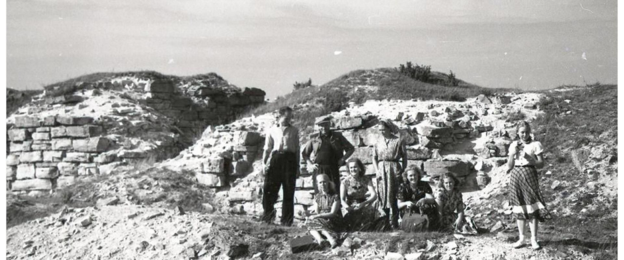
A group of people in front of the ruins of Maasilinn Castle before the excavations. Ruins of Maasilinn Castle (SM F 633 Fn); Saaremaa Museum Foundation; smf633_pisipilt.jpg.
Maasilinn Castle has stood in ruins since 1576. According to an earlier description, the ruins were completely covered with soil and debris, making it difficult to discern the castle’s overall layout. Restoration work at Maasilinn began in late 2001, funded by Orissaare Municipality. During this work, the largely preserved ground floor and entrance gate were excavated. Today, the surviving section of the main building stands 7.5-8 metres high, comprising the ground floor and part of the first floor.
The castle also had its own harbour, making it accessible by sea but also vulnerable to attack. The pirates known as the Victual Brothers, who dominated the Baltic Sea in the late 14th and early 15th centuries, raided the coast of Saaremaa twice in 1427. During the war between the Teutonic Order and Danzig in 1458, ships from Danzig sailed directly into Maasilinn’s harbour, and the forces that landed there ravaged the possessions of both the Order and the bishop.
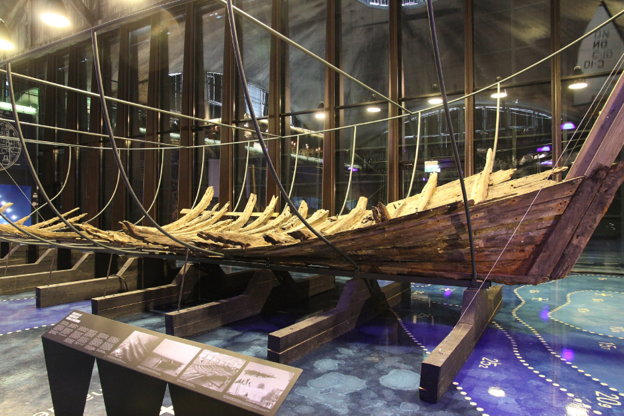
The Maasilinn ship at the Seaplane Harbour. Wikimedia Commons.
The famous Maasilinn ship was also discovered in the harbour waters. Built on Saaremaa in the 1550s using locally sourced timber, it was a single-masted vessel measuring 15-16 metres in length and 5.5 metres in width. It was probably used primarily for sailing in local waters, although voyages farther afield in the Baltic Sea cannot be ruled out. Today, the ship can be seen at the Seaplane Harbour in Tallinn.
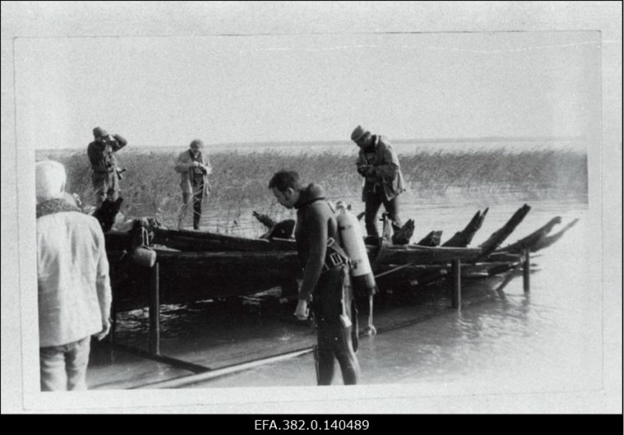
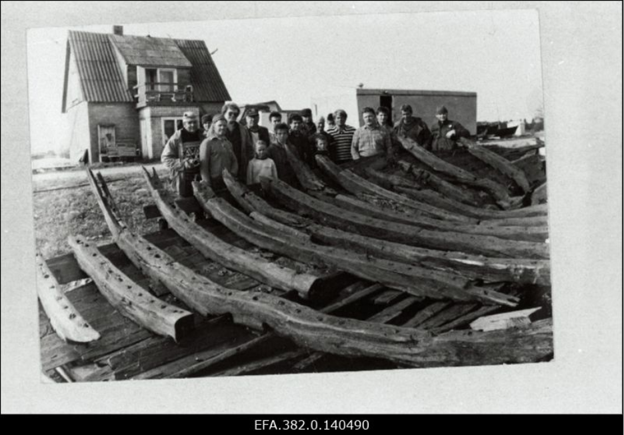
The Maasilinn ship was discovered in 1985 and raised from the water in 1988 by members of the Viikar Diving Club. EFA.382.0.140489, EFA.382.0.140490.