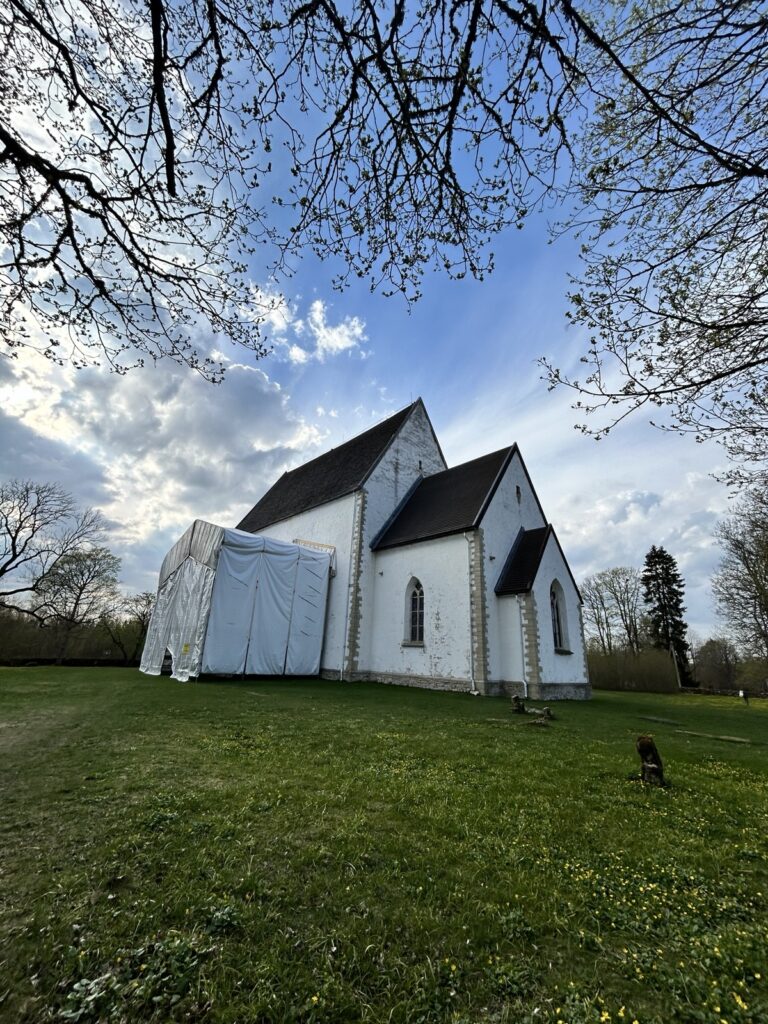
St Catherine’s Church in Muhu, viewed from the northeast (2026). Photo: Piia Sandra Palm.
St Catherine’s Church in Muhu is located in the village of Liiva on Muhu Island. Like Karja Church, it is dedicated to St Catherine of Alexandria. Muhu Church is regarded as one of Estonia’s most outstanding examples of Early Gothic architecture. Its exterior is characterised by monumental proportions and a clearly articulated three-part structure.
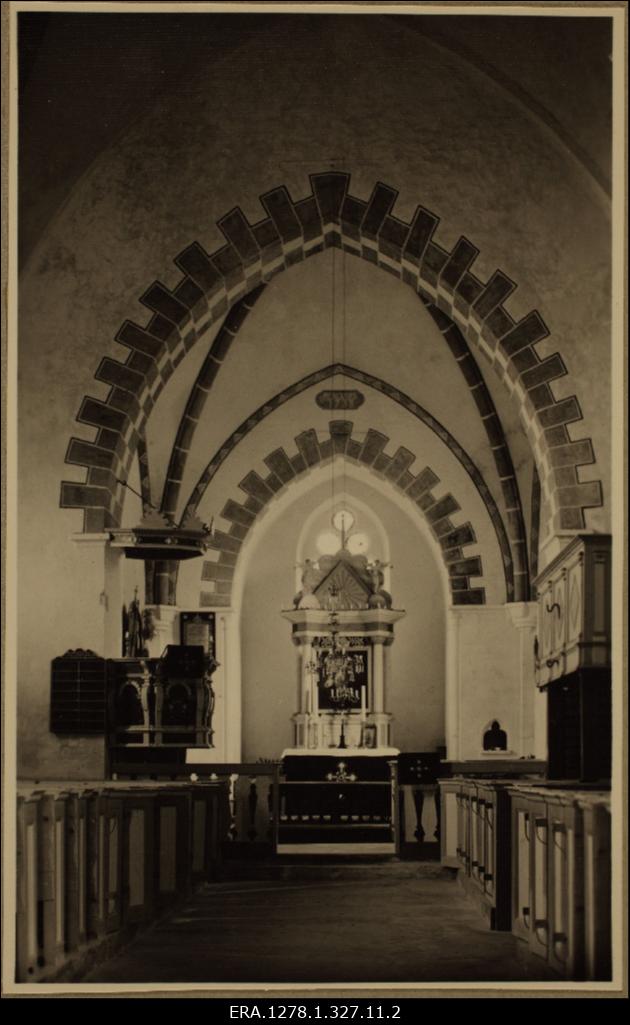
The altar and chancel of Muhu Church in the 1930s. Source: ERA.1278.1.327.11.2 (AIS).
The precise chronology of the church’s early construction history remains uncertain. Muhu hillfort is located just 3.8 km from the church. According to Henry of Livonia’s Chronicle, the hillfort was destroyed in 1227 by a combined crusader army following fierce fighting. Although the hillfort has not been archaeologically investigated, several rich hoards have been discovered in its vicinity, along with archaeological evidence of a substantial settlement nearby.
1233. aasta lepingu järgselt kuulusid Muhu valdused Mõõgavendade ordule, hiljem Saksa ordu Liivimaa haru valduste alla. Kirikut mainitakse esmakordselt Hermann von Wartberge kroonikas seoses 1267. aastaga. Ühe tõlgenduse kohaselt võis see teade puudutada praegusele kivikirikule eelnenud puust kirikut ning praeguse kivist pühakoja ehitamist alustati alles 13. sajandi lõpukümnenditel. Ent ei saa välistada, et praeguseni säilinud kivikirik võis olla ka valmis juba 1267. aastaks.
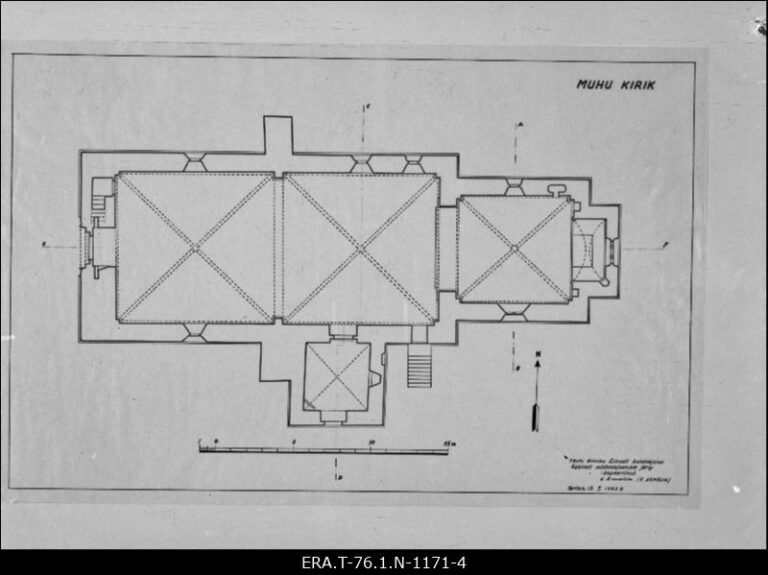
Floor plan of Muhu Church (1955). Source: ERA.T-76.1.N-1171-4 (AIS).
The single-nave church visible today was constructed in several stages. Initially, probably in the second half of the 13th century, most of the nave walls were erected, a staircase was built into the thick western wall, and narrow lancet windows were installed in the side walls.
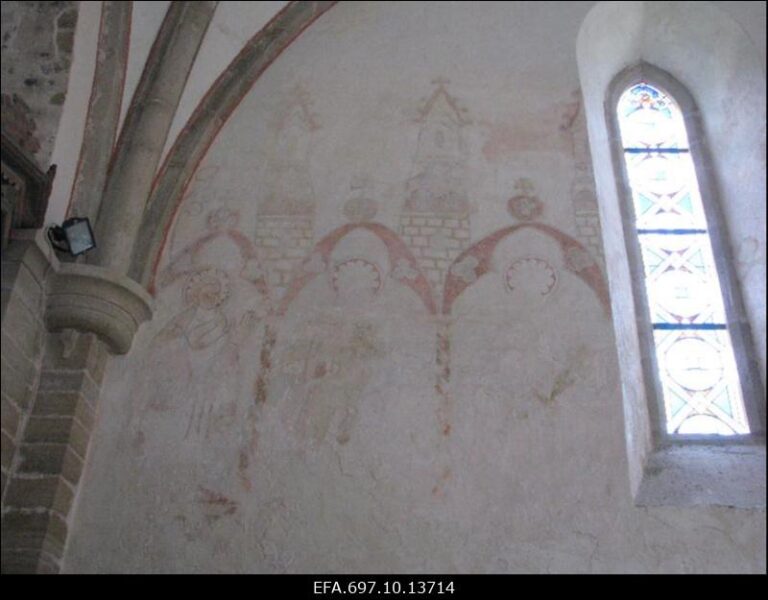
Figurative wall paintings in the western section of the north wall of Muhu Church’s chancel. Source: EFA.697.10.13714.
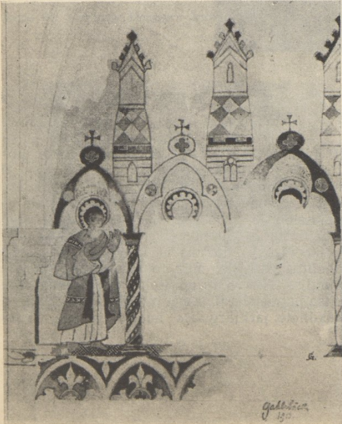
Drawing of a figurative wall painting in Muhu Church by Johannes Leopold Gahlnbäck, a Baltic German architect and art historian born on Saaremaa (1913). Source: Eesti Arhitektuuri Ajalugu (1965).
Towards the end of the century, however, this earlier church was demolished, and new master builders erected the chancel with its unusually small rectangular eastern termination, completed the construction of the nave, and connected the two spaces with a chancel arch. A master craftsman from Gotland decorated the chancel walls with figurative paintings executed using the secco technique, inspired by the Last Judgement. In the early 14th century, the nave was similarly decorated, probably also by a master from Gotland.
The eastern end of the chancel depicted scenes from the life of Christ, while the side walls featured prophets, the twelve apostles, martyrs, bishops, and other figures. Among them was a depiction of a knight of the Teutonic Order in the western section of the north wall.
Towards the end of the century, however, this earlier church was demolished, and new master builders erected the chancel with its unusually small rectangular eastern termination, completed the construction of the nave, and connected the two spaces with a chancel arch. A master craftsman from Gotland decorated the chancel walls with figurative paintings executed using the secco technique, inspired by the Last Judgement. In the early 14th century, the nave was similarly decorated, probably also by a master from Gotland.
The eastern end of the chancel depicted scenes from the life of Christ, while the side walls featured prophets, the twelve apostles, martyrs, bishops, and other figures. Among them was a depiction of a knight of the Teutonic Order in the western section of the north wall.
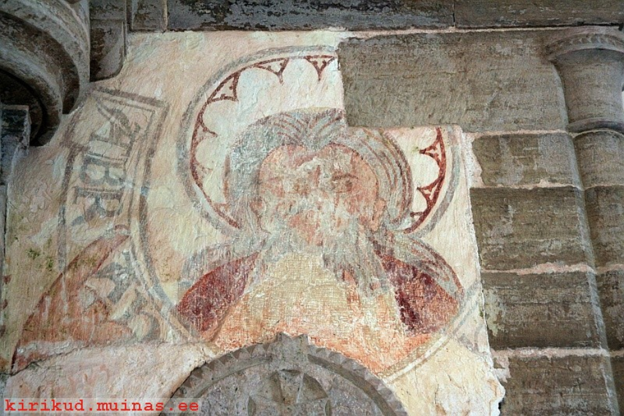
Depiction of Abraham (2007). Photo: M. Kallas.
Nevertheless, the church walls were whitewashed again in 1934, and it was not until the 1970s that the paintings were partially uncovered once more. In addition to the figurative paintings in the chancel, fragments have survived of a composition at its eastern end, in which the altar, symbolising the throne of Christ, was surrounded by four angels holding censers, alongside a depiction of Abraham.
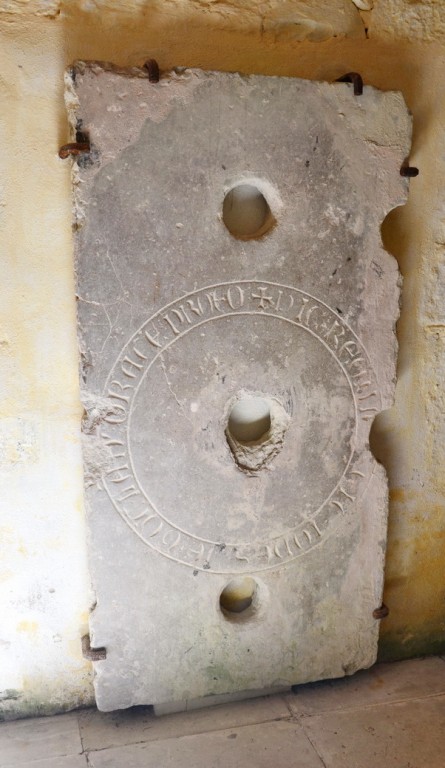
Grave slab possibly belonging to Master Johannes of Gotland (2012). Photo: Ü. Jukk.
One of the master craftsmen from Gotland may have been buried in Muhu Church, as a grave slab is located near the chancel arch, a particularly prestigious burial location. At the centre of the slab is an inscription reading: “Here rests Johannes of Gotland + pray for him.”
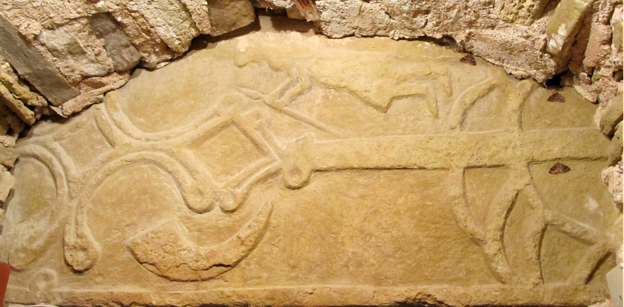
Trapezoidal grave slab from Muhu, depicting a warrior with a spear, a Calvary cross, and a drinking horn. Source: Wikimedia Commons.
An even more unusual trapezoidal grave slab is located in the staircase passage within the western wall, where it was reused as a door lintel. The slab depicts the figure of a warrior holding a spear in one hand, alongside a cross with a diamond-shaped centre, interpreted as a world tree, with a drinking horn on the other side. This type of cross is common on Romanesque grave slabs in Denmark and Poland, while similar examples can also be found on the doors of medieval churches on Gotland. It is associated with the Cross of Calvary.
The semicircular shapes beneath the cross may refer to stone graves in which members of the local elite had previously been buried and into which spearheads were inserted as symbols of high-status warriors. While drinking horns played an important role in sacrificial rituals in pre-Christian religious practices, Christianity associated the horn with salvation. In the Middle Ages, the drinking horn was also an important symbol of high social status. The trapezoidal grave slab at Muhu thus combines both pagan and Christian motifs, probably commemorating a warrior of high social standing.
The slab was most likely made in the early 13th century and originally marked the burial place of an important individual in contemporary society. When the church was rebuilt in the second half of the century, the grave slab was moved to the location where it remains today.
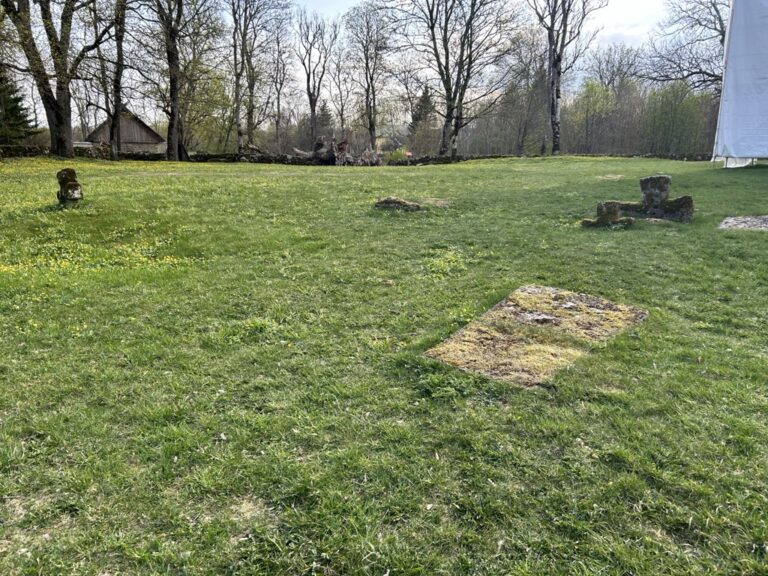
Grave slab and stone crosses in Muhu churchyard (2026). Photo: Piia Sandra Palm.
A third noteworthy grave slab at Muhu is located in the churchyard. It also features a drinking horn, but additionally depicts a Maltese cross and is framed by ornamental decoration. Once again, a parallel can be found on Gotland, where a very similar, partially preserved grave slab survives in Roma Church. In addition, several very old stone crosses have been preserved in Muhu churchyard.
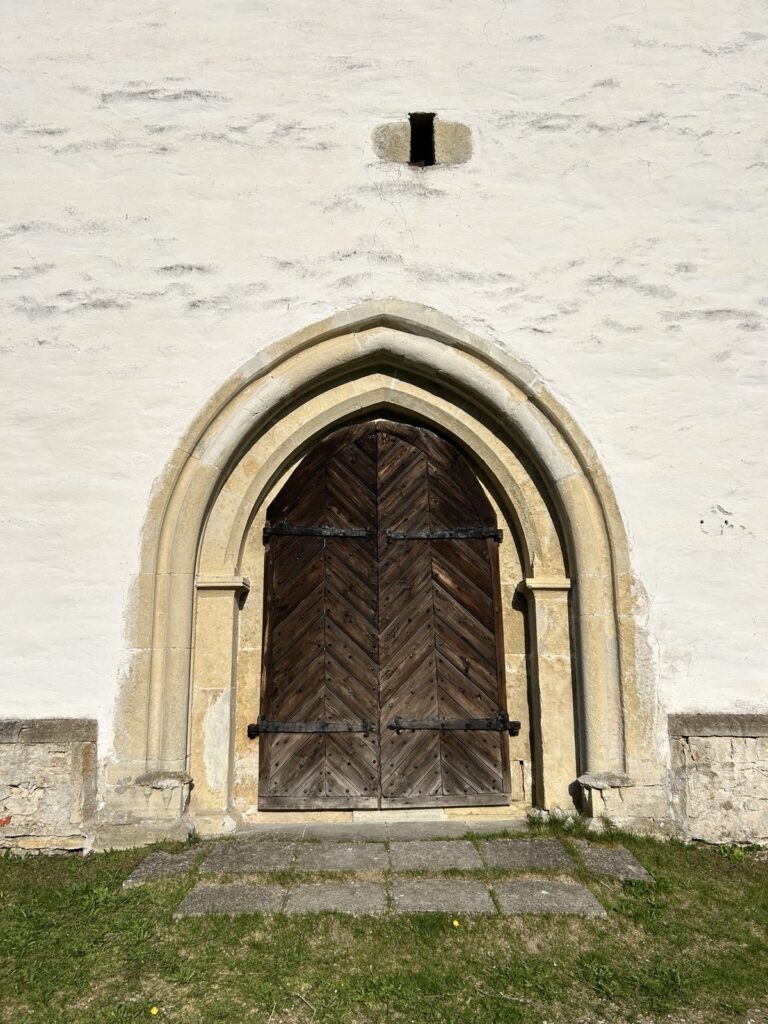
Door of the western portal. Photo: Piia Sandra Palm.
The church’s main entrance is located in the western wall, where a three-stepped pointed-arch portal contains a door dating from 1617. A similar architectural design can be seen in the main portals of Pöide and Karja churches. A second entrance is located in the southern wall, where there is also a porch and a portal that was probably originally situated in the western section. The church has no sacristy.
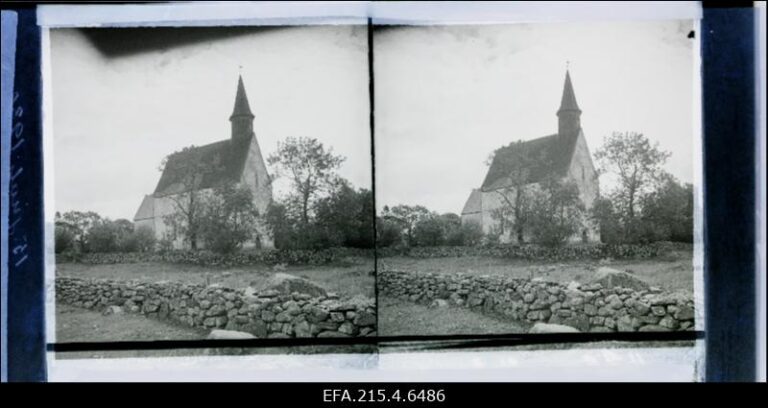
Muhu Church in the 1930s, with its bell turret topped by a weathercock still visible. Source: EFA.215.4.6486.
Later, in 1764, an octagonal wooden bell turret was constructed, topped by a iron weathercock.
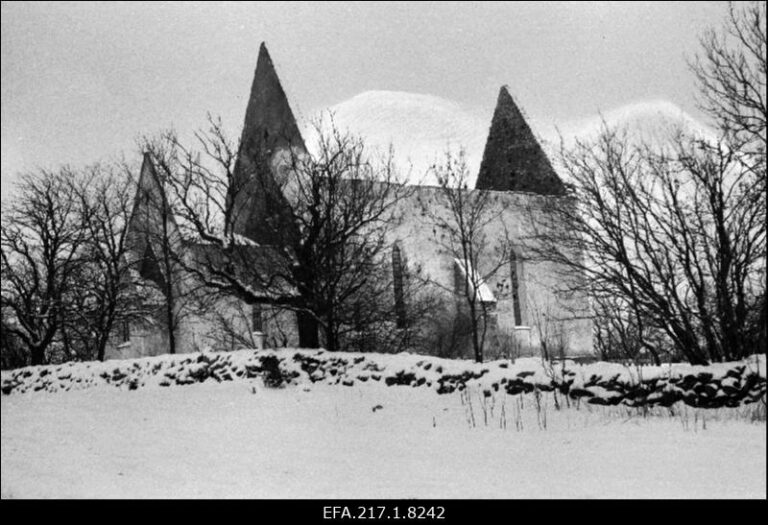
Muhu church in 1944. Source: EFA.217.1.8242.
The roof of Muhu Church, together with its bell turret, was destroyed during the Second World War on 15 September 1941. Part of the interior was also destroyed by fire. As the roof was not restored until 1959, the church remained exposed to the elements and various forms of damage for almost two decades. The chancel was the only part of the building to receive a temporary protective roof, which helped preserve some of its wall paintings.