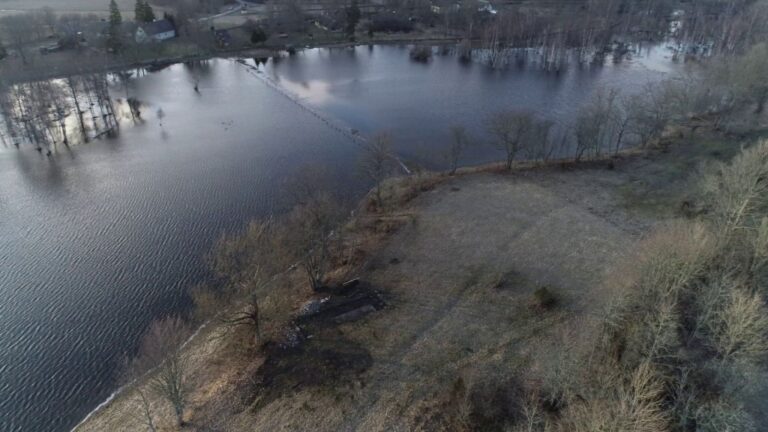
View of the Asva settlement from the southeast. The archaeological excavation trench (2019) is visible in the photograph. Photo: Maili Roio.
The Asva fortified settlement, also known as Asva hillfort and locally as Linnamäe Field (Linnamäe põld), is located in the southeastern part of Saaremaa. It is one of the most important archaeological sites in both Saaremaa and Estonia as a whole, and one of the richest Bronze Age settlements in terms of archaeological finds on the eastern shores of the Baltic Sea. The earliest settlement at Asva dates to the Late Bronze Age, approximately the 9th-6th centuries BC. Thereafter, the site remained unoccupied for a considerable period. The next traces of settlement date only to the later phase of the Middle Iron Age, approximately the 7th-8th centuries AD.
The settlement is situated on a narrow moraine ridge rising up to eight metres above the surrounding terrain, with a plateau covering approximately 3,500 m². During the Bronze Age, however, the landscape differed considerably from that of today, with the coastline lying much closer to Asva, facilitating contact and interaction between its inhabitants and the wider world.
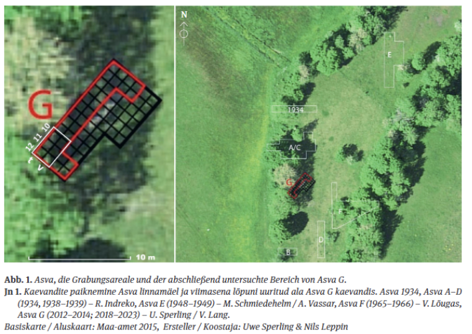
Archaeological excavation trenches at Asva over the years, with Trench G being the most recent. Source: Sperling, U., Karlsen, H.-J., Lang, V., von Fournier, K., Läänelaid, A., Sohar, Kr. (2024). Abschlussarbeiten am Westhang der Bronzezeitsiedlung von Asva. Einige stratigrafische und dendroarchäologische Beobachtungen. Archaeological Fieldwork in Estonia, 2023, 45–54.
Archaeological research at Asva dates back almost a century. The first excavations took place in 1934, followed by further investigations in 1938–1939 under the direction of Richard Indreko. Subsequent major excavations were conducted by Marta Schmiedehelm and Artur Vassar in 1948–1949, and by Vello Lõugas in 1965-1966. A new phase of research began in 2012 with excavations in Sector G, located in the southwestern part of the plateau. Excavations were carried out there between 2012 and 2014 and, following a three-year hiatus, resumed in 2018 and continued until 2023.
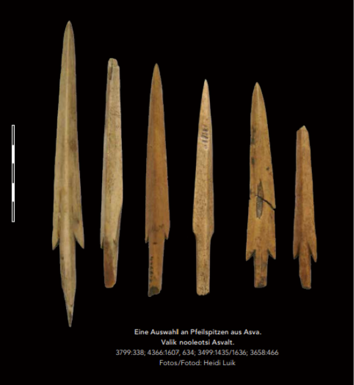
A selection of bone arrowheads from Asva. Source: Sperling, U., Karlsen, H.-J., Õispuu, A.-L., Jark, V., Gerding, T., Papenhagen, M., Schille, S., Leppin, N., Schmidt, M., Rosentreter, L., Engesser, Ch., Nitzsche, Chr., Just, J.P., Neuhof, H., Dost, A., Reinke, E., Bruhn, F., Behn, J. (2024). Archäologische Funde aus der Bronzezeitsiedlung von Asva. Präsentiert von Rostocker Studierenden / Arheoloogilised leiud Asva pronksiaegsest asulast. Rostocki ülikooli tudengite uurimused. Tallinn: Arheoloogiakeskus.
The economy of Late Bronze Age Asva was diverse. Its inhabitants kept cattle, sheep, pigs, and horses, and cultivated barley, wheat, oats, and legumes. Barley grains are the most common among the charred cereal remains and represent the oldest known finds of barley in Estonia! Traces of cereals have also been identified on the surfaces of pottery vessels. A large number of grinding stones and handstones, predominantly made from local granite, have also been discovered at Asva. These indicate the processing of grain and other materials, including flour production, which took place mainly outdoors.
Seal hunting was also of considerable importance, while the bones of elk and other wild animals have been found in significantly smaller quantities. Seals were hunted using harpoons made from elk antler. Fishing was also practised, while bone arrowheads were used for hunting. Bone and antler working took place within the settlement itself, as evidenced by numerous unfinished objects and production waste.
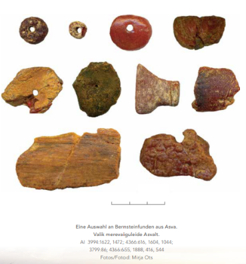
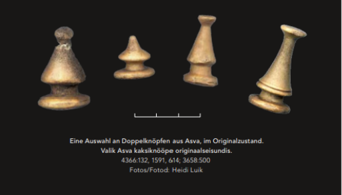
Amber objects and double buttons made from elk antler found at Asva. Source: Sperling, U., Karlsen, H.-J., Õispuu, A.-L., Jark, V., Gerding, T., Papenhagen, M., Schille, S., Leppin, N., Schmidt, M., Rosentreter, L., Engesser, Ch., Nitzsche, Chr., Just, J.P., Neuhof, H., Dost, A., Reinke, E., Bruhn, F., Behn, J. (2024). Archäologische Funde aus der Bronzezeitsiedlung von Asva. Präsentiert von Rostocker Studierenden / Arheoloogilised leiud Asva pronksiaegsest asulast. Rostocki ülikooli tudengite uurimused. Tallinn: Arheoloogiakeskus.
In total, more than 60,000 pottery sherds, amounting to approximately 500 kg of ceramics, have been recovered from Asva. The pottery reflects both local traditions, including influences from Comb Ware and eastern ceramic traditions, as well as Central European influences, represented by fineware bowls with handles and angular profiles. Finds of jewellery and clothing fasteners include bone pins and double buttons made from elk antler and amber. More than 120 pieces of amber have been discovered, most of which consist of raw amber. Finds from the Vintri site on the Sõrve Peninsula suggest that at least some of the amber may have been collected locally on Saaremaa. In addition, more than 15 kg of burnt clay daub has survived from the buildings. Impressions of logs and wattle preserved in the daub indicate the presence of timber structures.
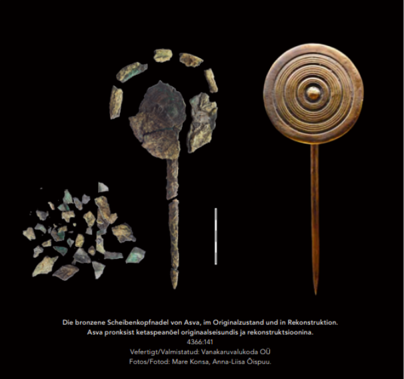
A bronze disc-headed pin found at Asva and its reconstruction. Source: Sperling, U., Karlsen, H.-J., Õispuu, A.-L., Jark, V., Gerding, T., Papenhagen, M., Schille, S., Leppin, N., Schmidt, M., Rosentreter, L., Engesser, Ch., Nitzsche, Chr., Just, J.P., Neuhof, H., Dost, A., Reinke, E., Bruhn, F., Behn, J. (2024). Archäologische Funde aus der Bronzezeitsiedlung von Asva. Präsentiert von Rostocker Studierenden / Arheoloogilised leiud Asva pronksiaegsest asulast. Rostocki ülikooli tudengite uurimused. Tallinn: Arheoloogiakeskus.
What makes Asva truly exceptional, however, is the intensive bronze casting that took place there. Approximately 3,000 fragments of ceramic casting moulds have been recovered from the settlement, and the most recent excavations focused specifically on a bronze-casting workshop. The vast majority of the moulds were used to cast rings, although multi-part moulds for spearheads, socketed axes, and jewellery have also been found. For example, fragments of a mould used to cast a decorative disc-headed pin nearly 20 cm long have been discovered, along with fragments of a casting mould for a Scandinavian-type plate brooch. The latter represents the first evidence of the production of Scandinavian Bronze Age brooches in the eastern Baltic region.
In 2020, an oval hearth cut into the underlying glacial till was uncovered, measuring approximately 90 × 40 cm and 25–30 cm deep. It was filled with charred wood, and a fragment of a casting mould was found at its base. The hearth may have been used for smelting or for producing charcoal needed in the metalworking process. Antler tool handles, a grooved hammerstone, and other stone tools potentially used in metalworking were also recovered nearby. Animal bones, fish remains, pottery sherds, and a spatula-shaped spoon made from antler were also found around the hearth, indicating that food preparation took place in the same area.
Bronze casting thus appears to have been carried out outdoors, on a seasonal basis, alongside other domestic activities. Since the metals required to produce bronze alloys are not naturally available on Saaremaa, the craftspeople of Asva must have maintained extensive contacts across the Baltic Sea.
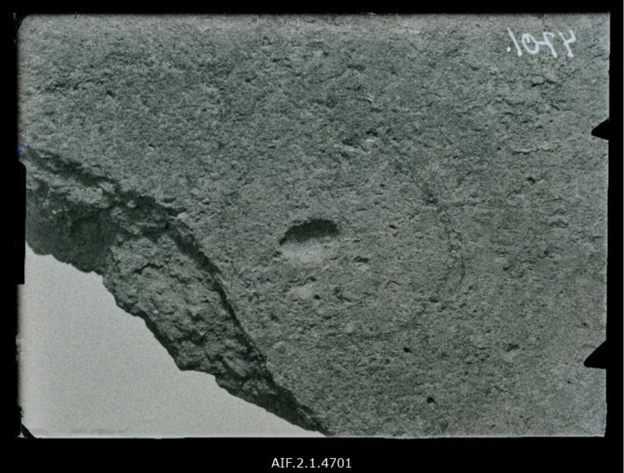
Pottery sherd with an impression of a cereal grain from the Asva settlement (1939). AIF.2.1.4701.
The most recent excavations have also provided a clearer understanding of the stratigraphy of the Late Bronze Age settlement. At least two distinct phases of occupation can be identified. The earlier phase includes the remains of a burnt building with clay-daubed walls, a hearth, a stone-slab pavement at a depth of approximately 70–85 cm, and a bronze-casting area.
During the later phase, the area was used primarily for waste disposal. The stone slabs associated with this phase were initially interpreted as the remains of a defensive wall surrounding the settlement. However, they were actually arranged in several layers, with animal bones, pottery sherds, and fragments of casting moulds found between and beneath them. This indicates that the structure was not the foundation of a wall, but rather a pathway or ramp that was gradually renewed over the waste deposits accumulating on the slope.
Fragments of a young individual’s skull were also uncovered in the most recent excavation trench. These remain the only human skeletal remains discovered at Asva to date.
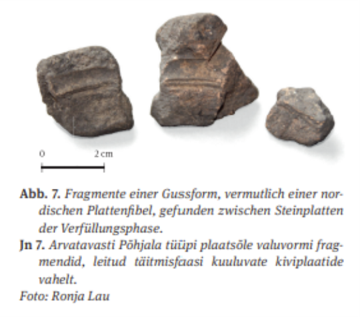
Casting mould fragments. Source: Sperling, Uwe; Karlsen, Hans-Jörg; Lang, Valter; Lõugas, Lembi; Kimber, Andres; Lau, Ronja (2020). Ausgrabungen in der Bronzezeitsiedlung von Asva im Jahr 2019. Archaeological Fieldwork in Estonia, 2019, 51–60.
Following the end of the Late Bronze Age occupation, the site remained uninhabited for centuries. A new settlement was established there only during the Middle Iron Age, around or after AD 600. It was probably during this period that Asva acquired a more distinct hillfort character, becoming a fortified elevated site. The edges of the plateau were levelled and filled in, and the ground level was artificially raised, although the nature of the defensive structures remains unclear. Evidence of these levelling and filling activities is visible in all excavation trenches as an intermediate layer of light-coloured limestone gravel. This layer separates the Bronze Age deposits from the later occupation layers and reaches a thickness of up to 40 cm along the edges of the plateau.
The Middle Iron Age cultural layer is poorly preserved, as the hillfort was ploughed in the post-medieval period and stones were removed from its ramparts. In the interior of the plateau, so much of the cultural layer has been disturbed or removed that the underlying glacial till is exposed in places at a depth of just 30-35 cm. As a result, Bronze Age artefacts have also been found in later layers.
During the 2018 excavations, a limestone structure dating to the Middle Iron Age was uncovered at a depth of 15–20 cm. It consisted of a north–south-oriented band of stone slabs approximately 1.8 m wide. A similar structure had already been discovered during the 1938 excavations, a few metres further north, where it was bordered by the charred remains of wooden logs. Researchers therefore suggest that, at least during one phase of occupation, a stone-paved path or walkway approximately 1.8-2 m wide ran along the western edge of the plateau. No traces of a wall or foundation have been identified. It is possible that a wooden defensive structure or palisade stood alongside the path, although its precise construction cannot currently be determined with certainty.
What makes Asva particularly valuable to Estonian archaeology is the preservation of evidence from two widely separated periods at the same site. The Late Bronze Age settlement (approximately the 9th-6th centuries BC) provides insights into the dwellings, animal husbandry, seal hunting, craftsmanship, and contacts across the Baltic Sea during that period. It offers particularly extensive evidence of bronze casting, which was practised intensively at the site, although apparently on a seasonal basis and using relatively simple equipment.
After a hiatus of more than a thousand years, the site was reoccupied during the Middle Iron Age, in the 7th–8th centuries AD, when a fortified hillfort was probably established there. Archaeological research at Asva thus contributes to our understanding of both the development of Bronze Age society in Estonia and the significance of Saaremaa in the pre-Viking Age Baltic Sea region.