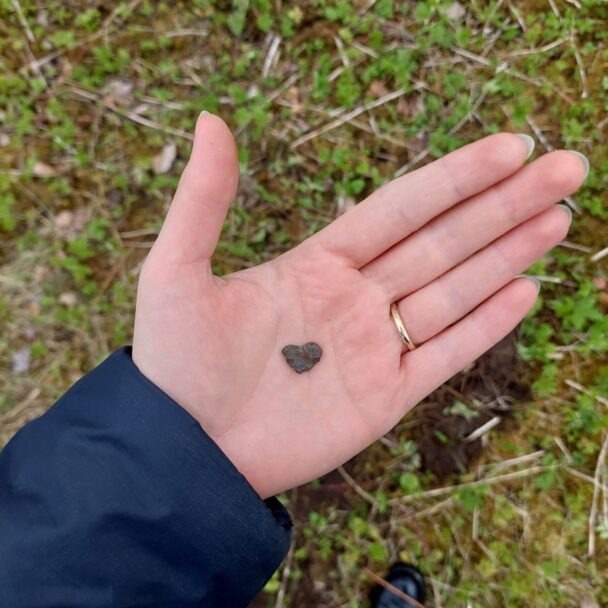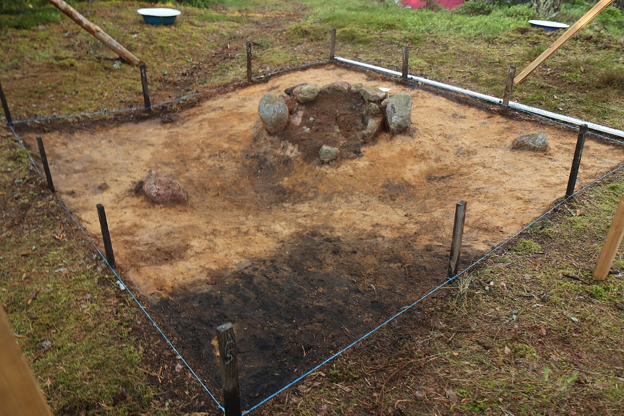
Remains of a 13th–14th-century iron-smelting furnace discovered at Tuiu Rauasaatmemäed. Photo: Ragnar Saage.
Tuiu Rauasaatmemäed is located in northern Saaremaa, near the village of Tuiu, west of Lake Järise and Pelisoo Bog. It is the largest known prehistoric and early medieval iron production centre in Estonia, where iron was produced from approximately the 8th century until the late 14th or early 15th century. Iron production reached its peak between the 12th and 14th centuries. Today, evidence of this once extensive iron production can be seen in the heaps of iron slag scattered across the pine-covered sandy dunes, the remains of smelting furnaces, and other archaeological finds.
The development of iron production in the Tuiu area was facilitated by favourable natural conditions. Deposits of iron-rich bog ore were available nearby, while the surrounding forests provided the timber needed for charcoal production. Iron production required large quantities of both ore and fuelwood, making it practical to establish smelting furnaces close to the sources of raw materials. Studies of sediments from the nearby Jõhvikasoo Bog have revealed a marked increase in charcoal particles as early as the Viking Age, indicating an intensification of human activity in the area that may have been associated with the beginnings of iron production.
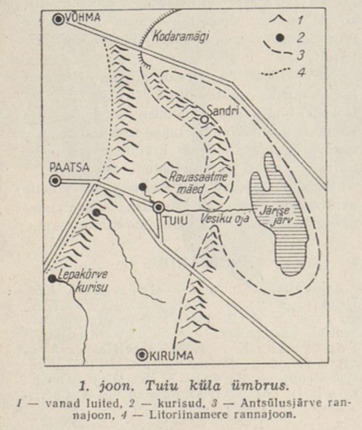
Landscape in the Tuiu area. Source: Eesti Loodus, No. 3 (May-June 1966), p. 162.
During the peak of iron production at Tuiu, a total of approximately 1,500–2,000 tonnes of iron may have been produced. This volume of production probably exceeded the needs of the local population and it has been suggested that iron was also produced for trade and sale. The iron may have been used to manufacture tools, weapons, shipbuilding components, and other iron objects. More than 50 iron-smelting sites have been discovered in the Tuiu area, each associated with one or more slag heaps. The larger heaps may contain 30–40 tonnes of iron slag.
Iron production at Tuiu was based on local bog iron ore, one of whose main advantages was its low phosphorus content. This made it possible to produce high-quality, easily workable iron and steel. Iron smelting was carried out in clay furnaces that were partially sunk into the ground and supported externally by stones. The internal diameter of the furnaces was approximately 30 centimetres. During the smelting process, iron ore was heated with charcoal, while air was supplied to the furnace to achieve the high temperatures necessary for extracting iron from the ore. This process produced a spongy mass of raw iron, known as a bloom, which subsequently had to be consolidated and purified of slag through forging. The molten slag generated during smelting was drained from the furnace through specially designed openings. The process was labour-intensive and required considerable skill in furnace construction, temperature control, and the subsequent working of the iron.
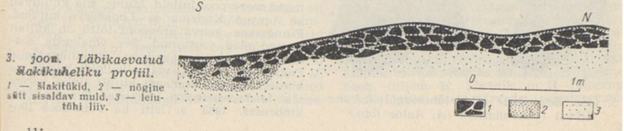
Drawing by Aita Kustin of the investigated heap of slag. Source: Eesti Loodus, No. 3 (May-June 1966), p. 163.
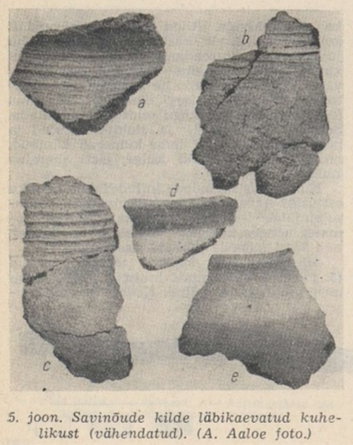
Drawing by Aita Kustin of pottery sherds discovered in the investigated slag heap. Source: Eesti Loodus, No. 3 (May–June 1966), p. 164.
Tuiu Rauasaatmemäed attracted the attention of researchers as early as the 19th century. Baltic German scholars described the local slag heaps and recorded oral traditions according to which Swedes had once smelted iron there. The first archaeological investigations did not take place until 1962, under the direction of archaeologist Aita Kustin, who excavated one of the slag heaps. In addition to iron production waste, pottery sherds were also discovered in the heap. Some of these retained a layer of burnt residue on their inner surfaces, suggesting that the vessels had been used for preparing or consuming food.
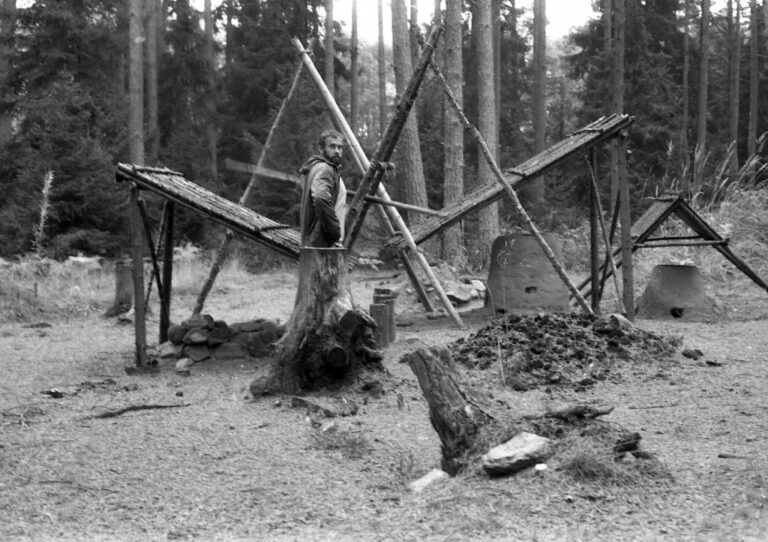
Jüri Peets reconstructing an ancient furnace in 1988. Photo: V. Ahonen.
Research at Tuiu gained new momentum in the 1980s, when Jüri Peets investigated the remains of smelting furnaces and conducted experimental iron-smelting trials. In 1988, an experimental furnace was constructed based on an ancient model in an attempt to recreate the iron production technology used centuries earlier. One of the experimental furnaces was subsequently left exposed to the elements to observe its deterioration and compare the results with archaeological furnace remains.
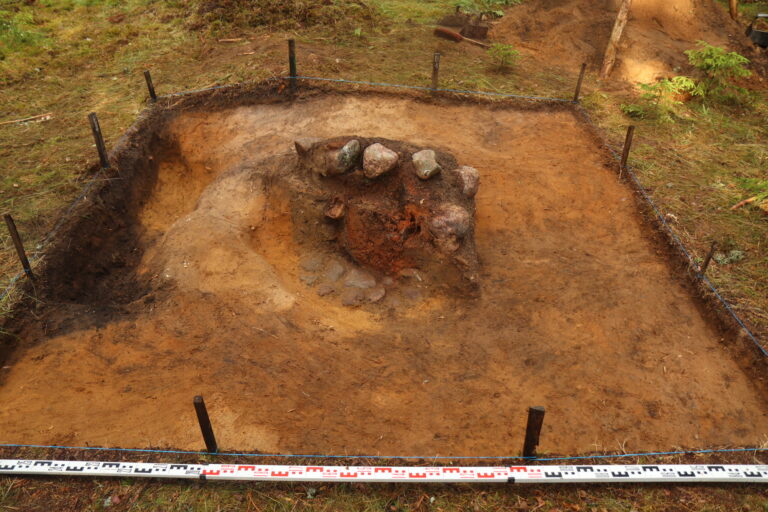
The experimental furnace built in 1988, excavated in 2022. Photo: Ragnar Saage.
An important new phase of research took place in 2022, when Agnes Unt, Ragnar Saage, Kristo Oks, and Jüri Peets investigated the remains of both a medieval smelting furnace and an experimental furnace built in the 1980s. The excavations provided new insights into the construction and operation of the medieval furnace. The investigations also included an analysis of a piece of raw iron discovered at Tuiu. Metallographic analysis revealed that it consisted of high-carbon steel, with a carbon content of at least 0.8%. Radiocarbon dating placed the find between AD 1279 and 1394. These results confirm the high technological standard of iron production at Tuiu and provide valuable information about metallurgical expertise in medieval Saaremaa.
Although extensive iron production took place at Tuiu Rauasaatmemäed over several centuries, no evidence of permanent settlement dating from this period has been found at the site itself. However, the remains of a hillfort and several smithies dating from the 11th to the 17th centuries have been discovered at Paatsa, approximately two kilometres away. It is therefore possible that the iron smelters working at Tuiu lived in the Paatsa area.